
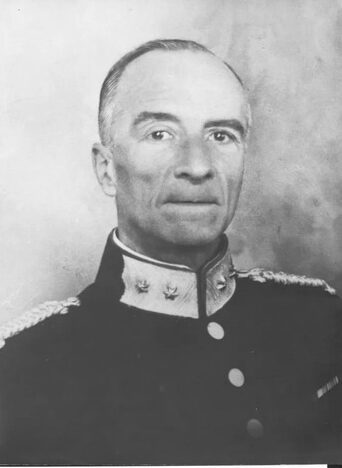
When I was younger I vaguely recall hushed conversations about a branch of the Kerlen family who were pretty much ostracised. In fact if I recall correctly that particular branch of the family, or at least the descendents of also lived in South Africa. We never had anything to do with them. Whilst researching the family history I happened upon Gerardus Johannes Kerlen who was a Nazi collaborator during the war.
It’s no wonder then that they were ostracised, my grandparents were interned in Japanese concentration camps during the war. This particular member of the family was assassinated by a Dutch resistance member called Truus van Lier.
Gerardus Johannes Kerlen (1890–1943) was a high-ranking Dutch police official and Nazi collaborator during the German occupation of the Netherlands. He is historically significant as the highest-ranking police officer assassinated by the Dutch resistance during World War II.
Early Career and Background
Born on August 3, 1890, in Zutphen, Kerlen initially pursued a military career:
-
Military Service: He served as a lieutenant colonel in the Royal Netherlands East Indies Army (KNIL) and saw combat in Aceh.
-
Political Shift: He became a member of the NSB (National Socialist Movement in the Netherlands), the Dutch Nazi party, which facilitated his rise during the occupation.
Chief Commissioner of Utrecht
In August 1942, Kerlen was appointed Chief Commissioner of Police in Utrecht. His tenure was defined by strict adherence to Nazi ideology:
-
Nazification: He worked aggressively to transform the police force into a tool of the German occupiers.
-
Persecution of Jews: He established a specialized unit known as the “Jodenploeg” (Jew Squad), which was dedicated to hunting down, arresting, and deporting Jewish citizens in hiding.
-
Conflict with the Force: Kerlen faced significant internal resistance; when 180 officers refused to participate in the deportation of Jews, Kerlen threatened them with concentration camps, forcing many into hiding.
Assassination by Truus van Lier
Kerlen’s brutal tactics and his direct role in the persecution of the local population made him a primary target for the resistance.
-
The Date: September 3, 1943.
-
The Act: As Kerlen was walking home from his office at the Paardenveld to his residence at Willemsplantsoen, he was approached and shot by Truus van Lier, a 22-year-old law student and member of the resistance group CS-6.
-
Death: Kerlen died at the scene.
-
Consequences: Truus van Lier managed to escape initially but was arrested a few weeks later. She was deported to the Sachsenhausen concentration camp and executed in October 1943.
Historical Legacy
In modern Dutch history, Kerlen represents the extreme end of wartime collaboration. Conversely, the spot where he was killed (and the nearby Truus van Lier-bridge in Utrecht) has become a symbol of Dutch resistance. Recent biographies and historical projects, such as Jessica van Geel’s Truus van Lier, have shed new light on the life of his assassin and the impact of Kerlen’s regime on the city of Utrecht.